Tips for Bass Players
Preface: I've been playing a long time and am primarily self taught, but I did have personal lessons with some great musicians. The only reason this page exists is because some people reached out to me for assistance. There are players who have devoted their lives to teaching music and I would suggest reaching out to them as well.
Here are a few resources worth exploring: Adam Nitti Music Education, Scott's Bass Lessons, Tony Grey Bass Academy.
Below are some tips I've compiled over the years. I mostly learned to play by transcribing bass lines from my favorite records and playing in rock and fusion bands. I would learn things by ear and memorize them, internalizing the music. I rarely relied on written charts or tab and feel these can, if used as a crutch, impede the development of a good musical ear.
Tip 1 — If you feel you must have personal lessons, work with a teacher of like mind. The way they present material should make sense to you. They should understand and respect your goals. If you cannot afford personal lessons or if you are self motivated, simply teach yourself. There are many resources available online.
Tip 2 — Master your own mind by learning how you learn. If you allow outside forces to completely impose a system of learning it can slow your progress. Take what you are presented and rearrange it so it's compatible with how you learn. In the end a great teacher will teach you how to teach yourself.
Tip 3 — Keep a categorized practice log. Log your progress every day. Change up your routine to keep progressing.
Tip 4 — Practice as much as you can and keep it fun. If it isn't fun you are likely to self-limit. It is still hard work — there's no way around that.
Tip 5 — Listen to the music that inspires you as much as possible. Immerse yourself in it, but don't be afraid to explore other types of music. Keep an open mind and open ears.
Tip 6 — Make your own music. It doesn't matter what level you play. If all you know is a major triad, make music with it. Making music is human. You are qualified by virtue of being human and having picked up an instrument.
Tip 7 — Sit or stand straight, breathe deep and relax. Experiment with different positions and strap heights until it feels effortless. Don't use too much force with either hand — be gentle and play expressively.
Tip 8 — Practice at different tempos. Play things slowly first until nearly perfect then gradually increase speed. Break what you practice into small sections. Focus on the rough spots.
Tip 9 — Practice with different EQs and pickup positions, with and without reverb and delay, because all of these should affect your expression. Practicing with a flat EQ is a great default.
Tip 10 — Practice to music, a metronome, and a drummer or drum machine. Learn bass lines, chords and melodies to your favorite songs.
Tip 11 — Fast impressive figures can add sonic interest but there is more emotional power in slower melodic movements.
I've learned that people will forget what you said, people will forget what you did, but people will never forget how you made them feel. — Maya Angelou
Tip 12 — When it comes time to play, it is not really time to be thinking. That should mostly be done during practice. Divide your practice times from your playing times — they are two different mindsets.
Tip 13 — Surround yourself and play with musicians that are more advanced than you. Join a band. Play and jam with your friends. It's the best way to improve.
Scales, Modes & Arpeggios
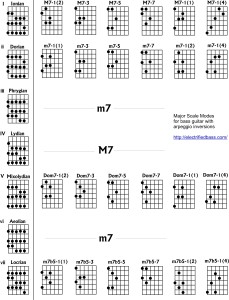
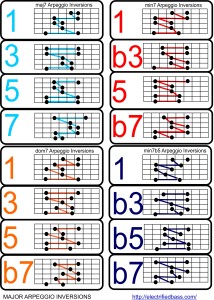
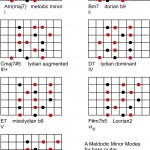
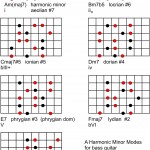
Here are charts for major modes and arpeggio inversions, as well as harmonic and melodic minor modes and arpeggios — presented in ways that made sense to me. Please enjoy and share them freely.